

How to use the
Abundance for All
Lens

The Abundance for All Lens is a tool to help you make informed, values-aligned decisions when voting. This is not about telling you who to vote for. This is about giving you a way to evaluate whether candidates and measures align with the future our communities have dreamed of.
-
![]()
Start with the Pillars
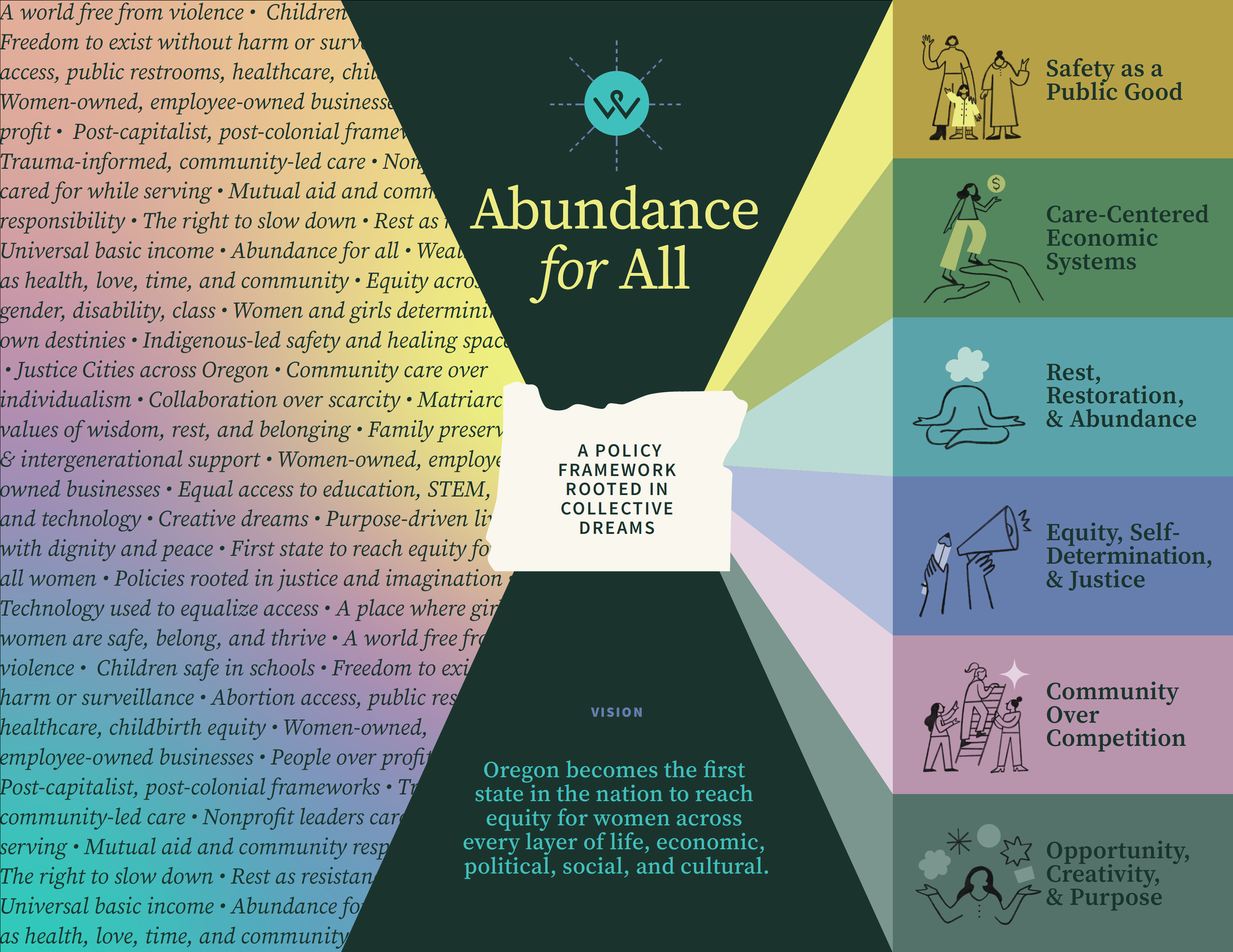
The pillars are a collection of dreams from community. At Women’s Foundation of Oregon, we believe Dreaming is Data. The Dreams of our community have created the data needed for Abundance for All lens.
Ground yourself in the six pillars of Abundance for All.
As you review candidates or ballot measures, ask:
Which pillar is most important for me?
Does this reflect the kind of world we are trying to build?
-
![]()
Review the Candidate or Measure in Four Areas
For each candidate or ballot measure, using the pillars look at:
1. Candidate / Ballot Website
2. Voting Record (if applicable)
3. Endorsements
4. Campaign Finance
-
![]()
Apply the Lens
For each pillar, ask:
● Does this candidate or measure move us closer to this vision?
● Where do I see alignment?
● Where do I see gaps?
There is no “perfect” candidate.
This process is about alignment, not perfection. -
![]()
Make Your Decision
Use what you’ve learned to make a choice that reflects:
● Your values
● Your community’s needs
● Our shared dream/vision of abundance




A Final Reminder
Abundance for All is rooted in the belief that:
● Policy should reflect our collective dreams
● Communities deserve transparency and clarity
● Voting is one way we shape the future together
Your voice matters. Your vote is part of building what comes next.
How to Review a Voting Record
Pay attention
to impact.
Consider how their votes have affected communities like yours. Who benefits? Who is left out? This is where connecting back to the Abundance for All pillars is key.
This tool is not about catching perfection, it’s about understanding alignment. Voting records help reveal how candidates translate values into action. As you review, ask yourself: Do these decisions move us closer to the future we are dreaming of for our communities?
Where to Find Voting Records
State (Oregon Legislature)
Use the Oregon Legislative Information System (OLIS) to search bills, legislators, and voting history
Federal (U.S. Congress)
Here you can review voting records for members of Congress.
County and City Levels
Voting records at the local level can be more decentralized, but they are still accessible:
County Commissioners: Check your county’s official website. Look for meeting agendas, minutes, and recorded votes.
City Council: Visit your city’s website and review council meeting archives, which often include vote tallies and recordings.
Many jurisdictions also post video recordings, allowing you to see not just how someone voted, but how they discussed the issue.
Political Endorsements (Public Backing)
Endorsements are when an individual or organization publicly supports a political candidate, party, or policy. It’s essentially a way of saying: “I recommend or stand behind this person or idea.”
How to review endorsements
Review who is the endorser?
Does the endorser have credibility? Is it a trusted organization?
Values Alignment?
Does the endorser’s mission or ideology match the candidate’s platform? This is where connecting back to the Abundance for All pillars is key.
Consider potential bias or interests?
Does the endorser benefit financially or politically?Are there known affiliations that might influence their support?
Measure impact
Did the endorsement lead to increased donations, media coverage, or polling changes? AIs it being widely shared or discussed?
Where to Find Endorsements
Candidate Campaign Websites
Most candidates list endorsements on their official pages under sections like Endorsements or Supporters.
Ballotpedia
Ballotpedia tracks endorsements for many races, often compiling;Notable individuals, Organizations, Political figures
Vote Smart
Vote Smart, formerly known as Project Vote Smart, is an American non-profit, non-partisan research organization established to collect and distribute factual information on U.S. candidates for public office.
County and City Levels
Endorsements at the local level can be more decentralized, but they are still accessible:
County Voter Pamphlet
County Political Party Websites
Local Unions & Community Organizations
This tool isn’t about judging perfection,it’s about understanding alignment. Political endorsements can offer insight into how candidates translate their values into action.
As you review endorsements, consider the bigger picture: Do these individuals or organizations help move us closer to the future we envision for our communities?

Candidate Website
The purpose of a political campaign website is to serve as a central platform for candidates to communicate their message, values, and policy positions in their own words.
How to find the website
Do a quick search of candidates name and position they are running for. For example “Jane Doe, County Commissioner.” Their website will also be listed in the voter pamphlet.
The website generally contains more information about the candidate personally as well as their stance on a variety of issues. Some things to consider when reviewing a candidate’s website:
What issues are highlighted and which issues are missing - If you care about a particular issue and the candidate fails to mention it, consider if that candidate is in alignment with your values.
Taxes and tax policy. Taxes are policy in action - what issues does the candidate want to fund versus where do they want to defund with tax dollars?
Effectiveness. Do they have a track record of success, are they endorsed by folks who share your values, do you believe this candidate will make choices that will lead to Abundance for All?
Event calendar. Attending a forum or an event where the candidate will speak can be a valuable way to learn more about them and where they stand.

Follow the money
Campaign finance is a concrete way of tracking who is funding campaigns. All political entities whether they are a candidate, Political Action Committee (PAC), a ballot measure, political party, etc. that intends to influence elections are required to report their moneys received and how it was spent. Campaign finance is not limited funds, but also includes gifts (e.g. your skills as a web designer, physical office space, supplies, etc), loans, and other in-kind donations.
Federal
All federal elections (U.S. House of Representatives, U.S. Senate, President) must be reported to the Federal Election Commission (FEC). Contributions totaling more than $200 in a calendar year per person must be reported including the identity of donor, address, occupation, and employer. All federal contributions can be viewed on the FEC’s website.
State of Oregon
Oregon law requires all committees (campaign) to register with the Secretary of State (SOS) once it has received or spent $1,500. Additionally, all donations totaling more than $100 per person per election must report the individual’s name, address, occupation, and employer.
Currently, Oregon has no limit to state-level contributions for a committee. This will change starting Jan 1, 2027, with a maximum of $3,300 per person per election committee. Many local committees (City of Portland) have their own limits. All local committee contributions can be viewed on ORESTAR. You will be asked to create a login, which is free to create.

Political Mailers and ads
It’s also important to look at political mailers and ads that are not connected to a candidate or measure but are a separate entity. It is often PACs who have a vested interest in one of the other candidate(s) or ballot measure. An environmental organization will support a candidate that is committed to protecting our green spaces, clean air, etc. A business group will likely consider taxes, zoning, etc.
Want to learn more about campaign finance? Check out the SOS’s Campaign Finance Manual here.